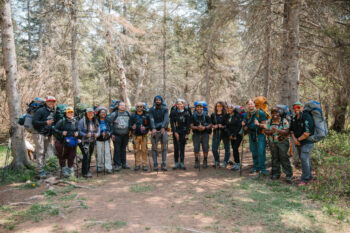

Isle Royale for All
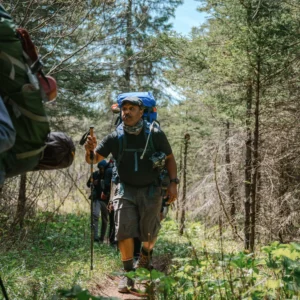
As we walked along the trail from our first campsite at Washington Creek, I was immediately struck by how lucky we were. It was an absolutely perfect day at Isle Royale National Park. With a slight breeze, temperatures in the mid 70s, and not a mosquito in sight, the conditions couldn’t have been better.
Our initial plan to hike from Ozaagaateng, formerly known as Windigo, to Huginnin Cove was simple enough. By all accounts, it was a three-mile hike from the trailhead to a beautiful, secluded spot on the shores of Lake Superior. It was a perfectly manageable distance for a crew of novice backpackers camping overnight for the first time.
But little did we realize that the starting point for that distance was more than a mile from where we had pitched our tents the night before. With a bit more distance to travel than we had originally anticipated, I came to realize a simple but unassailable truth: future favors the prepared, but luck is what happens when preparation meets unforeseen circumstances.
Truthfully this was a detail I had missed. My production partner, Alice Lyn, the creator and host of the Michigan Public Television program, Color Out Here(Opens in a new window), and I had made a trip to the island several months earlier. With less than 24 hours to explore, we scouted the group campsites and other amenities for a small production crew and a team of 8 environmental educators from Detroit and Grand Rapids. We planned to come back the following year to film a three-part PBS documentary series. Our goal for this project was to navigate and illustrate the inherent barriers to accessing the least visited National Park in the lower 48 United States. Principal among those hurdles is apparently failure of logical planning.
There are only two ways to get to Isle Royale National Park: by boat or by seaplane. No roads connect this remote archipelago in Lake Superior to the mainland. You cannot drive to the entrance, park your car, and walk a few hundred yards to a visitor center. Getting there requires a deliberate crossing of the largest freshwater lake in the world. And once you arrive, whatever you need must either be waiting for you to purchase at the camp store or carried in your backpack.
In order to cut down on the travel time after a drive of almost 6-hours to the town of Houghton on the Upper Peninsula of Michigan, the most convenient option was to travel by seaplane. Our reservation for 12 people had to be booked 6 months in advance. The journey by air takes about 45 minutes, while a ride by ferry could take another six hours! Though much less expensive, there are only so many seats on the boat each season. The factor of limited transportation options on and off the island means fewer than 30,000 people can visit Isle Royale each year.
The only downside to flying there, apart from the cost of $420 round-trip, is the seaplane requires a maximum pack weight of 45 pounds for each passenger. Loaded with backpacking equipment and camera gear for three days on the island, we just barely made it.
The challenges of just getting there can make Isle Royale seem inaccessible long before anyone sets foot on the island. But the difficulty of reaching a place does not necessarily mean that you don’t belong there. Sometimes it simply means you need to prepare.
That was one of the ideas behind Isle Royale for All(Opens in a new window). Our goal wasn’t to pretend that backpacking on this remote island is easy or cheap. It isn’t. Nor was it to eliminate every possible obstacle before we arrived. No amount of planning can control Lake Superior, change the weather, flatten a trail, or guarantee that everything will go according to plan. Instead, we wanted to find out what happens when preparation becomes a means of making adventure more accessible.
Isle Royale is a place where distance has always mattered. Known to the Anishinaabe as Minong, often translated as “the good place,” the island has a human history stretching back thousands of years. Long before ferries and seaplanes, people crossed Lake Superior by water. Their movements are shaped by weather, seasonality, and the temperament of the lake itself. That remains true today. Lake Superior still sets the terms.
One of our participants, Grant Gliniecki, is an Anishinaabe environmental advocate with ancestral ties to Michigan’s Burt Lake Band. He helped me to think about preparation in another way. “One of the most important things I’ve been taught is that land has a culture,” he said. “Everywhere I go that isn’t home, I’m a visitor.” For Grant, that understanding comes with a responsibility to pay attention to the place itself. We must learn something about the land, the people connected to it, and what it means to be a good visitor while you are there.
For us, preparation meant understanding those terms before we left home. It meant thinking carefully about packs and footwear, food and shelter, insect protection, and water treatment. It meant understanding National Park Service regulations and knowing what facilities would—or would not—be available once we reached our campsite. It meant asking not simply, “What do I need?” but “What might somebody else in our group need in order to have a good experience?”
That extra distance meant an 8-mile round trip would be closer to 10. With heavy packs, some of our less experienced participants struggled under the weight of their load. The trails on Isle Royale are a combination of long stretches of rolling terrain through thick stands of trees. Occasionally we encountered steep inclines or sudden downhill descents. With such a large group, it was difficult at times to keep everyone moving forward at an efficient pace. But with great weather, even better company and all day to get where we going, the journey was long but still very pleasant.
Our plan included a two-night stay at the Huginnin Cove campsite. A layover day assured everyone had plenty of time to rest and relax in a beautiful setting with a stunning view of Lake Superior. That gave us a bit of wiggle room to address the difficulties of our participants who might have been carrying more gear than they needed.
The warm dry weather meant we didn’t need a lot of rain gear or insulating layers. We had two days of empty dehydrated food packages, a few drained camera batteries and a tripod we weren’t using. Eager for another full day off hiking, I and three of the more experienced members of our group carried the extraneous gear in our packs back to the ranger station at Ozaagaateng. A ten-mile round trip on this clear summer day was time well spent.
The following morning, we broke camp and made the hike back all over again. Fortunately, the return trip for the entire team was easier than we could have imagined. Though a slightly longer distance, the trail was mostly downhill as the majority of the elevation gain came in the first 4 miles. We arrived back to the seaplane base with plenty of time to enjoy the mild weather by the lake before our flight brought us back to the mainland.
In the end, our good fortune at Isle Royale wasn’t that everything went according to plan. We hiked farther than expected, carried more weight than some of us should have and spent a rest day walking ten miles to make the next day easier. We were lucky with the weather, certainly, but preparation gave us the freedom to make the most of that luck. More importantly, it gave us the capacity to take care of one another when circumstances changed.
“I would never have imagined myself here,” Alice reflected during our trip, “or if I did imagine myself here, I would have imagined being miserable and woefully unprepared.” Now, after helping bring this group together, she told us, “I’m especially grateful for how I’ve learned to feel like I’m worthy of being here.”
Isle Royale—or Minong—may never be easy to reach. Perhaps that is part of what makes “the good place” so special. The lesson we carried home was that accessibility doesn’t always mean removing every obstacle. Sometimes it means having the equipment, information, time and community necessary to meet those obstacles together. Fortune may favor the prepared, but adventure favors those prepared to adapt.