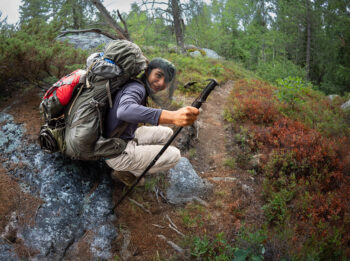

Two Chicago Teenagers and the Lessons of the Wild
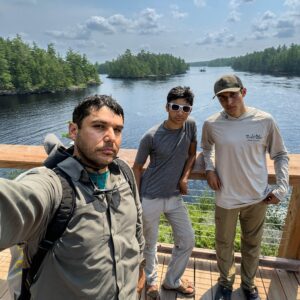
This story was written by Franco Torres, Stefen Del Toro and Isaí Madriz.
When Franco, Stefen and I began our journey through Voyageurs National Park, I knew the expedition would challenge them physically. What I did not know was how differently each of them would experience the same landscape—and how much they would learn from it.
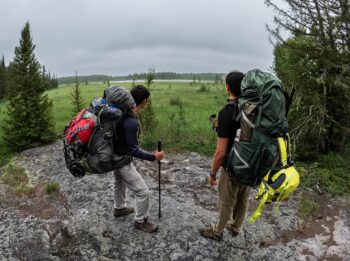
For me, the trip was an opportunity to mentor two young people in an environment far removed from the conveniences of everyday life. For 17-year-old Franco, the expedition became a lesson in slowing down and truly observing the natural world. For 16-year-old Stefen, it became a test of physical and mental endurance. Although we traveled together, each of us experienced a different journey.
We began with a lesson on packing equipment and understanding the weight and space limitations on a real unassisted expedition scenario. After each of us selected our equipment and packed our respective belongings, we drove overnight to the put-in and got our boats loaded and ready.
The water shimmered beneath the morning sun. Coming from Chicago, Franco and Stefen were accustomed to buildings, cars, traffic, and the constant presence of people. They had never needed to walk for miles carrying a heavy backpack for hours. This would be their first experience of a multi-day camping experience and using a packraft.
At first, the journey seemed easy.
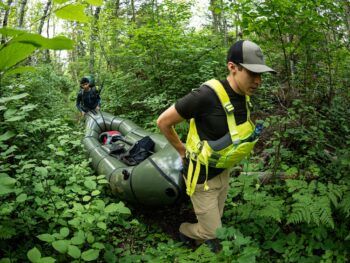
We paddled across the lake before reaching our first portage. Franco and Stefen worked together to carry their gear across. That was when reality began to sink in. The trail was uneven, covered with rocks and branches, and carrying the two-person packraft and equipment (over 90 lbs. combined) across it was much harder than they thought.
Once we entered the water at the other end, Franco noticed a green frog along the shoreline as he stepped into the water. It was a small moment, but Franco later expressed it represented something I hoped they would learn during the expedition: wilderness travel is not simply about reaching a destination; it is about noticing what exists along the way.
We continued paddling and eventually reached the shoreline. Packing wet equipment back into already heavy backpacks proved challenging, but Franco and Stefen managed it. We then hiked through the woods toward the campsite.
For Franco, the campsite itself was fascinating. There was no check-in, no building, and no conventional campground infrastructure. There was simply a patch of earth outlined by wooden planks. We had a lake essentially to ourselves. For Stefen, the experience was like none other.
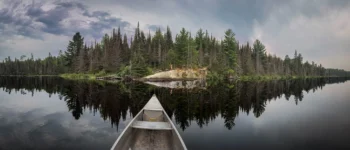
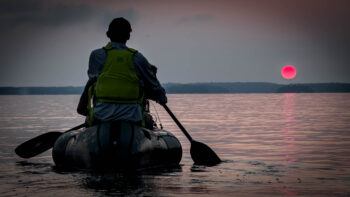
That evening, Franco took a canoe from the dock and spent hours on the water. Eventually, he watched the sunset.
For him, the landscape was already becoming something more than a place through which we were traveling.
Stefen, however, was beginning to discover the physical demands of the expedition.
The next day we woke at five in the morning and continued our journey. I immersed them in the accountability side of overseeing the navigation responsibilities each day. We would all rotate. That day, Franco overtook the assigned obligation.
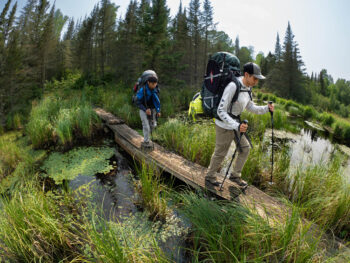
We hiked for hours with our backpacks weighing approximately forty-five pounds each. The terrain was uneven, and the weight became increasingly difficult to carry.
At one point I noticed that Stefen did not follow my recurring advice to drink water and he became severely dehydrated, so I made the decision to stop and allow him to recuperate. I provided him with electrolytes, and he began to feel better within minutes. Once he regained his strength, we reached the nearest stream and after fully rehydrating we continued our journey.
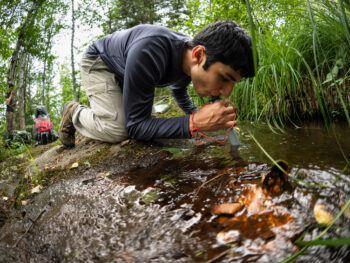
For Stefen, that moment became an important lesson.
In his words “I began to understand that strength is not simply the ability to carry heavy things or move quickly. Sometimes strength means recognizing that you have reached a limit, accepting help, recovering, and then continuing.”
As we marched forward, we reached Anderson Bay Viewpoint. From the overlook, we could appreciate the surrounding landscape and see Canada in the distance.
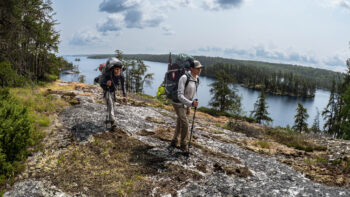
The landscape was beautiful, but neither of the young men could experience it without first confronting the demands of getting there.
As we continued forward, Franco became aware of the importance of using the proper gear and was impressed by the hiking backpack he was borrowing from me. He compared how different this pack was in comparison with his regular school pack and said to me “this large pack distributed the weight evenly and allowed me to organize equipment both inside and outside the bag. Having the proper equipment made a huge difference.”
As we continued paddling, the sun became increasingly hot. Along the way, the tall trees, textured bark, water, animals, and shoreline created an environment unlike anything he normally experienced. For Franco, these encounters reinforced the feeling that the landscape was alive around us. For Stefen, the same environment was becoming a test of endurance.
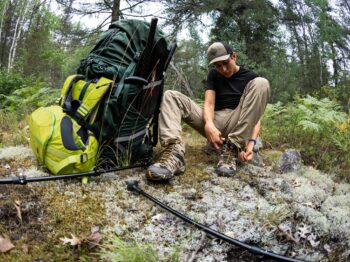
Eventually, we reached another campsite. Everyone was tired. We prepared food, boiled water, dried clothes, and organized our equipment.
The campsite had a pit toilet with walls—the first “indoor” toilet experience for both Franco and Stefen after days utilizing open pit toilets.
These details may seem insignificant in ordinary life. In the wilderness, however, they become part of the experience of adapting to a simpler way of living, allowing them to appreciate the meaning of privacy.
The following morning began early again. As we traveled, they both seemed to learn another lesson in the absence of trash. Because of the pack-in, pack-out ethic, the landscape remained remarkably clean. They recognized how regulations and responsible behavior can protect ecosystems and allow people to experience the great outdoors in its most natural state.
As we approached the portage near Kettle Falls, the physical demands soon returned. We pulled the packrafts onto the dock, removed the backpacks, and began carrying our equipment across the trail.
For Franco, the half-mile portage felt endless. The terrain rose and fell, and the weight became increasingly difficult. He and Stefen stopped repeatedly to recover.
When we finally reached the water again, Franco was hungry, sleepy, and exhausted. The opposing current made paddling more difficult, and his instinct was to work harder and move faster because he simply wanted to reach the campsite.
I noticed he was overexerting himself, so I showed him a different paddling technique and assisted him in finding a pace he could control. That changed his approach and Franco slowed down.
Once he stopped treating the journey as something he needed to finish as quickly as possible, he noticed the landscape again. By slowing down, he began seeing things he would otherwise have missed; among them were two otters swimming near the campsite.
For Franco, this became one of the most important lessons of the expedition “sometimes we become so focused on completing something that we fail to experience it” he said to me.
Stefen was learning a different lesson.
At this point, his body was deflated. The miles of hiking, his heavy backpack, paddling, heat, biting flies, and the limited rest had accumulated. When we reached camp, he was so tired that he fell asleep on a rock for two hours.
We placed most of our belongings in the bear-proof food storage lockers and soon after came the storm.
That night, thunder began rolling across the lake. The wind shook the tents, and rain started pouring onto the ground.
Franco’s tent came under increasing pressure. Wind pushed it to one side, and eventually it collapsed. He reached outside into the muddy water, searched for the metal stakes, and pushed them deeper into the saturated ground.
Then the hail began.
The sound of hail striking the tent frame added another dimension to the storm. Water pooled around the tents, the ground softened, and then Franco’s tent collapsed again.
The rain poured down, the winds increased and the hail intensified. Stefen’s tent flooded.
At that point, too tired to move, Franco and Stefen curled up on their mats and managed to sleep despite the cold and wet conditions.
Stefen experienced the storm as the culmination of several days of physical exhaustion.
The next morning, our equipment was soaked and covered in mud. We each guarded our electronics inside our dry sacks, which were the only dry things in our tents. We cleaned what we could in the lake, packed everything again, and made our way back to the pier where our vehicle was.
The final stretch of the journey required 12 hours of paddling back toward the car. Along the shore dozens of large trees laid horizontal, exposing their shallow roots. They had succumbed to the strong winds from last night’s storm. A clear reminder of the forces of nature.
For Stefen, the journey had become a test of mental strength.
He had experienced moments when he wanted to quit. His body had been tired, and there were times when continuing seemed almost impossible. But he kept telling himself to go a little farther. One more step. One more paddle stroke. For him, that became the meaning of strength; “Strength was not necessarily feeling strong. Strength was continuing even when you did not feel strong.”
Franco came away with a different but complementary lesson.
He discovered that progress does not always mean moving faster. Sometimes progress means finding a sustainable pace, looking around, and allowing yourself to experience the moment.
Together, their experiences revealed two sides of the same wilderness lesson.
Franco learned to slow down; Stefen learned to keep going; And both learned that the wilderness exposes habits that are easy to hide in ordinary life.
In a life of convenience, food is readily available, water comes from a faucet, transportation is easy, bathrooms are nearby, and shelter is usually secure. We can move quickly from one task to another without thinking much about the physical effort required to sustain ourselves.
In the wilderness, those conveniences disappear.
You carry what you need. You prepare your food. You manage your water. You paddle when your arms hurt. You hike when your legs are tired. You adapt when the weather changes. And sometimes you must stop.
As a mentor, I could provide guidance, but I could not complete the journey for them.
When Stefen became dehydrated, I could give him something to help him recover, but he still had to continue.
When Franco was exhausting himself by paddling too hard, I could tell him to slow down, but he had to discover the value of that lesson himself.
That is what makes wilderness education so powerful. A mentor can provide direction, but the environment provides the lesson.
By the time we returned to the car, we were worn out. But we had gained something that could not have been learned as easily in a classroom.
Franco had discovered the importance of perspective and observation. Stefen had discovered his own capacity for resilience. And I had witnessed two young people encounter the same wilderness through completely different lenses.
The expedition taught us that survival is not only about physical strength. It is also about judgment, patience and adapting. It is about knowing when to slow down and when to keep moving. Most importantly, it is about understanding that discomfort does not necessarily mean failure.
Sometimes discomfort is where learning begins.
The wilderness does not care how strong we believe we are. It simply gives us the opportunity to discover what we are capable of, and sometimes being strong does not mean feeling strong. Sometimes it means slowing down enough to see the otters. Sometimes it means accepting help, and sometimes it simply means taking one more step—or one more paddle stroke—even when you believe you have nothing left.